A drill rig with a split-spoon sampler is how we start our soil liquefaction analysis in Fullerton. Our technician drives the sampler into the ground using a 140-pound hammer falling 30 inches, recording blow counts at every six-inch interval. That raw N-value feeds directly into the simplified procedure recommended by Youd and Idriss (2001) and the NCEER workshop. For projects near the Coyote Hills fault or along the Santa Ana River floodplain, this data helps us calculate the cyclic resistance ratio (CRR) and compare it with the cyclic stress ratio (CSR) generated by the design earthquake. It is a field-based method that gives you a defensible answer before you pour a single yard of concrete.
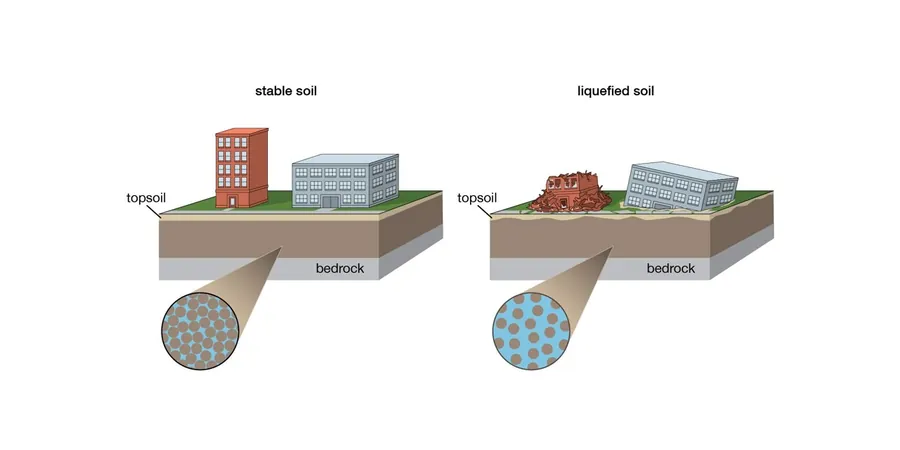
In young alluvial sands typical of Fullerton, a safety factor below 1.1 means you need ground improvement or deep foundations to avoid differential settlement after an earthquake.
Methodology and scope
Local considerations
Fullerton sits on the eastern edge of the Los Angeles Basin, where the groundwater table can be as shallow as 3 to 5 meters in the low-lying areas near the Santa Ana River. Combine that shallow water with the loose, fine-to-medium sands that dominate the subsurface in the western half of the city, and you have a textbook scenario for liquefaction triggering. A magnitude 6.5 earthquake on the Puente Hills thrust fault could generate peak ground accelerations of 0.4g or more in Fullerton. Under those conditions, saturated sand layers lose their shear strength and behave like a liquid. Buildings can tilt, underground pipes can float upward, and slabs can crack from differential movement. Our analysis identifies exactly which layers are at risk and calculates the post-liquefaction settlement so your structural engineer can design the foundation accordingly.
Applicable standards
ASCE 7-22 (Chapter 11 and 21 – Seismic Hazard and Site Class), IBC 2021 (Section 1803 – Geotechnical Investigation and Liquefaction), NCEER 1997 / Youd-Idriss 2001 (SPT-based simplified procedure), ASTM D1586-18 (Standard Test Method for SPT)
Associated technical services
Field SPT and Sampling Program
Our crew mobilizes a truck-mounted drill rig to your site and performs standard penetration tests at intervals of 5 feet or as specified by the project geotechnical engineer. We collect disturbed and undisturbed samples for laboratory classification and moisture content testing. The N-values are corrected for overburden pressure and hammer efficiency before being used in the liquefaction triggering evaluation.
Liquefaction Hazard Report
After the field work, we compile a report that includes the corrected SPT profiles, calculated CSR and CRR values, factor of safety versus depth, and estimated post-liquefaction settlement. The report follows the ASCE 7 site-classification framework and provides clear recommendations for foundation type or ground improvement when the factor of safety falls below 1.1.
Typical parameters
Frequently asked questions
How much does a soil liquefaction analysis cost in Fullerton?
For a typical residential or commercial lot in Fullerton, the cost ranges between US$2,270 and US$4,710. This includes mobilization, drilling one or two boreholes to a depth of 40 to 60 feet, performing SPTs at 5-foot intervals, laboratory testing, and a written hazard report. The final price depends on the number of borings and the complexity of the soil profile.
What is the difference between liquefaction triggering and post-liquefaction settlement?
Triggering refers to the initial loss of strength when pore-water pressure equals the confining stress, causing the sand to behave like a liquid. Post-liquefaction settlement is the vertical compression that occurs after the excess pore pressure dissipates and the soil reconsolidates. Both must be evaluated separately. In Fullerton, post-liquefaction settlement often controls the foundation design because even a few inches of differential settlement can crack a slab or rack a structural frame.
Does my project in Fullerton need a liquefaction analysis?
The 2021 IBC requires a liquefaction evaluation for any building in Seismic Design Category C, D, E, or F when the site is underlain by loose, saturated granular soils. Most of Fullerton falls into SDC D or D+. If your project includes a school, hospital, or multi-story building, the city building department will almost certainly ask for a geotechnical report that addresses liquefaction. Even for a single-family home on a slab, a shallow groundwater table near the Santa Ana River corridor makes the analysis worthwhile.
Can I use Vs30 instead of SPT for the liquefaction analysis?
Yes, but the NCEER/Youd-Idriss simplified procedure is calibrated primarily to SPT N-values. Vs30 measured by MASW or downhole seismic methods can be used to estimate the site class per ASCE 7, but for the actual liquefaction triggering calculation, you still need SPT blow counts to apply the correction curves. In practice, we often combine both: Vs30 for the site classification and SPT for the layer-by-layer factor of safety. That dual approach gives you a more solid answer.
What happens if the factor of safety is below 1.1?
A factor of safety below 1.1 means the layer is likely to liquefy during the design earthquake. The report will recommend one or a combination of ground improvement methods: deep soil mixing, stone columns, dynamic compaction, or excavation and replacement of the liquefiable material. Alternatively, the foundation can be designed with deep piles or caissons that bypass the liquefiable layer and bear on competent strata. We include settlement estimates for each option so your structural engineer can compare costs and risks.