Fullerton sits on a mix of Quaternary alluvial deposits and older Pleistocene terrace material, with groundwater typically encountered between 6 and 12 meters below grade depending on the proximity to Coyote Creek. The local soils range from silty sands (SM) to low-plasticity clays (CL) with occasional gravelly layers, which makes the selection of reinforcement products critical for long-term performance. A proper geogrid specification must account for the soil's particle size distribution, the design life of the structure, and the allowable creep strain under sustained loads. For projects involving steepened slopes or retaining walls, we cross-reference the tensile strength and junction efficiency with the results from a slope stability analysis to ensure the reinforcement layer is adequate for the anticipated failure surfaces.
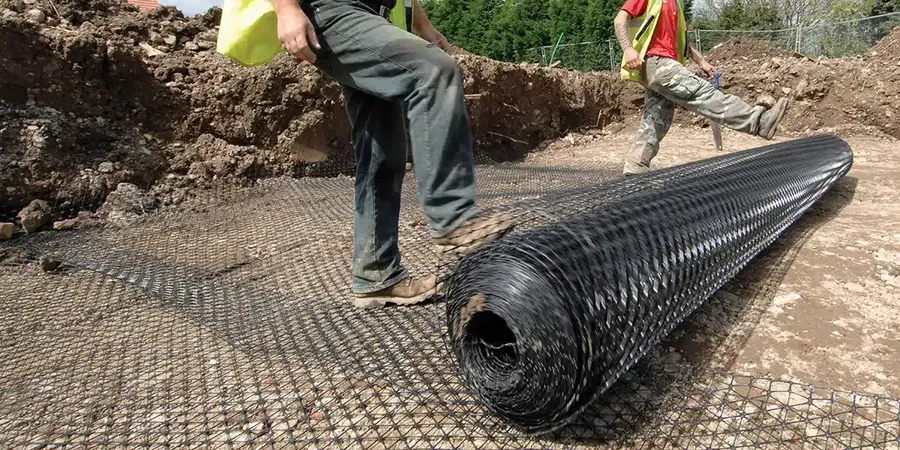
Geogrid specification in Fullerton demands creep reduction factors specific to polymer type and design temperatures between 20°C and 40°C.
Methodology and scope
Local considerations
A common mistake we see in Fullerton is specifying a geogrid based solely on the manufacturer's marketing tables without evaluating the actual subgrade conditions. For instance, a biaxial geogrid with 30 kN/m tensile strength might work fine in clean sands but can fail prematurely in the clayey silts found near the Fullerton Municipal Airport area due to inadequate pullout capacity. Another frequent error is ignoring the installation damage factor when the contractor uses heavy tracked equipment over the grid. We always recommend a site-specific index test program on the delivered rolls before the geogrid is placed, verifying that the roll width, aperture geometry, and tensile modulus match the project's design assumptions.
Applicable standards
ASTM D6637-18, GRI-GG2-19, ASTM D6706-18, IBC 2021 Section 1807, AASHTO R 50-19
Associated technical services
Pavement Subgrade Reinforcement Specs
We define the geogrid type, aperture size, and placement depth for flexible pavements over soft subgrades (CBR < 3). The specification includes the minimum tensile strength at 2% strain and the junction efficiency required to prevent lateral spreading of aggregate base layers.
Slope and Retaining Wall Reinforcement Specs
For reinforced soil slopes and segmental retaining walls, we calculate the required geogrid length, vertical spacing, and connection strength. The specification references the global stability factor from the slope analysis and the pullout resistance from site-specific soil parameters.
Custom Geosynthetic Index Testing
We coordinate with accredited labs to perform index tests on the proposed geogrid rolls — including wide-width tensile, junction strength, and durability tests — and issue a conformance certificate that verifies the product meets the project's technical requirements.
Typical parameters
Frequently asked questions
What is the typical cost for a geogrid specification report in Fullerton?
The cost for a complete geogrid specification report, including site-specific pullout parameters and manufacturer conformance review, ranges between US$390 and US$1,320 depending on the number of reinforcement layers and the complexity of the slope geometry.
How does the soil type in Fullerton affect geogrid selection?
The silty sands and low-plasticity clays common in Fullerton require geogrids with smaller apertures (25 to 35 mm) to ensure adequate interlock and prevent soil extrusion. The pullout coefficient for these soils typically falls between 0.80 and 0.95, so we specify a longer embedment length to compensate for the lower friction angles compared to clean sands.
What ASTM standards apply to geogrid specification in California?
The key standards are ASTM D6637 for tensile properties, ASTM D6706 for pullout resistance, and GRI-GG2 for junction strength. For projects under the California Building Code, we also follow IBC 2021 Section 1807 and the Caltrans Standard Specifications, which reference AASHTO R 50 for geosynthetic selection.
Can you specify geogrids for both temporary and permanent works in Fullerton?
Yes. For temporary works (construction platforms, haul roads) we specify uniaxial or biaxial geogrids with a creep reduction factor of 1.1 to 1.3. For permanent structures (retaining walls, reinforced slopes), we require PET geogrids with a creep reduction factor of 1.55 to 1.70 and a 75-year design life, along with UV resistance certification.