The hydraulic jack and reaction frame setup we bring to a Fullerton site is built for precision. We position a steel plate at the test depth, then apply load in controlled increments. A calibrated load cell and two dial gauges measure settlement to the nearest 0.01 mm. This direct method gives us the modulus of subgrade reaction (k-value) and the ultimate bearing capacity. In Fullerton's varied alluvial soils, from stiff clays to loose sands near Coyote Creek, the plate load test provides site-specific data that laboratory tests alone cannot replicate. We follow ASTM D1196-20 for every test, ensuring results that local geotechnical reports and structural engineers trust.
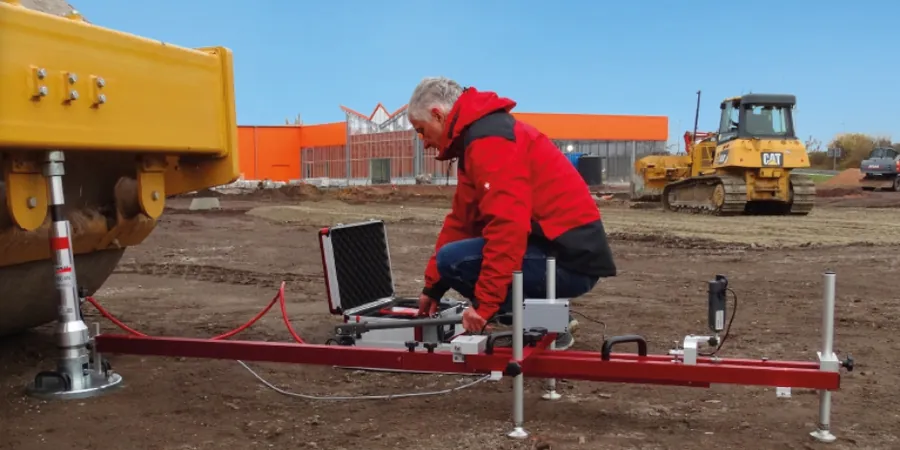
The plate load test measures how the ground actually settles under your footing load, giving the design team a direct k-value for foundation analysis.
Methodology and scope
Local considerations
Fullerton grew fast after World War II, when the orange groves gave way to housing tracts and industrial parks. That rapid development meant many lots were built with minimal geotechnical investigation. Today we see houses on spread footings that were designed with assumed bearing capacities. In older neighborhoods near downtown, undocumented fill from grading operations can hide loose zones. A plate load test on those existing soils reveals whether the assumed values hold up. Ignoring this step risks differential settlement that cracks slabs and tilts porch steps. The cost of a PLT is tiny compared to repairing a foundation that settled unevenly.
Applicable standards
ASTM D1196-20 (Standard Test Method for Nonrepetitive Static Plate Load Tests), ASTM D2487-17 (Classification of Soils for Engineering Purposes), IBC 2021 Chapter 18 (Soils and Foundations), ASCE 7-22 (Minimum Design Loads and Associated Criteria)
Associated technical services
Static Plate Load Test (ASTM D1196)
Standard non-repetitive test using a hydraulic jack and reaction frame. We perform one to three load-settlement cycles at your foundation depth. Results include bearing capacity and modulus of subgrade reaction for shallow foundation design. Ideal for spread footings, mat foundations, and pavement subgrades.
Repetitive Plate Load Test (for pavement design)
A multi-cycle version with unloading-reloading loops to measure the resilient modulus. Used for flexible pavement design on city streets and parking lots in Fullerton. We follow ASTM D1196 with additional cycles to simulate traffic loading. The output feeds directly into AASHTO pavement design equations.
Typical parameters
Frequently asked questions
How long does a plate load test take in Fullerton?
A typical static PLT takes about 2 to 4 hours in the field, including setup, loading, and teardown. If we need to reach a deeper test depth, the excavation adds time. We usually schedule a half-day per test location.
What is the difference between plate load test and CBR test?
The plate load test (PLT) measures the actual load-settlement behavior of the soil under a footing-sized plate, giving you bearing capacity and k-value. The CBR test is a laboratory penetration test for pavement subgrade design. PLT is a field test; CBR is lab-based. Both have their place, but for foundation settlement predictions, PLT is more representative.
How much does a plate load test cost in Fullerton?
The cost typically ranges between US$800 and US$1,190 per test location, depending on depth, access, and whether you need a full report with bearing capacity curves. We can provide a firm quote after reviewing your site plan and soil conditions.