Soil conditions differ sharply between Fullerton's Coyote Hills and the flat basin near downtown. The hillside areas expose older alluvial fans with lower plasticity, while the central basin contains thick Holocene clay layers that can settle several inches under load. For a preloading design without surcharge, the key parameter is the coefficient of consolidation (cv), which in Fullerton’s clay averages 0.02 to 0.08 cm²/s. That means primary consolidation can take 18 to 36 months depending on drainage path. We measure cv precisely in the lab using oedometer tests per ASTM D2435 before we model the fill schedule.
In Fullerton's central basin, OCR can be as low as 1.2, requiring precise σ'p measurement before setting fill height.
Methodology and scope
Local considerations
Fullerton sits at an elevation of roughly 50 meters above sea level, but the water table can be as shallow as 3 meters in the southern neighborhoods near the Santa Ana River. That combination of shallow groundwater and low OCR clay creates a high risk for excessive primary settlement. If the preloading design without surcharge underestimates the fill thickness needed, the foundation may settle 10 to 25 centimeters over two years. That kind of movement can break underground utilities and tilt slab-on-grade floors. We check the groundwater depth during the site investigation and adjust the drainage assumptions accordingly.
Applicable standards
ASTM D2435-04 (Oedometer Test), ASTM D4186-19 (Consolidation with Pore Pressure Measurement), ASCE 7-22 (Minimum Design Loads), IBC 2021 (Chapter 18 – Soils and Foundations)
Associated technical services
Oedometer Testing & Parameter Determination
We run incremental loading oedometer tests per ASTM D2435 on undisturbed samples from Fullerton. Each test yields cv, Cc, Cr, and σ'p. For soft clays, we also perform constant rate of strain (CRS) tests per ASTM D4186 to capture the creep rate. The lab reports include time-settlement curves for multiple fill heights.
Consolidation Modeling & Fill Schedule Design
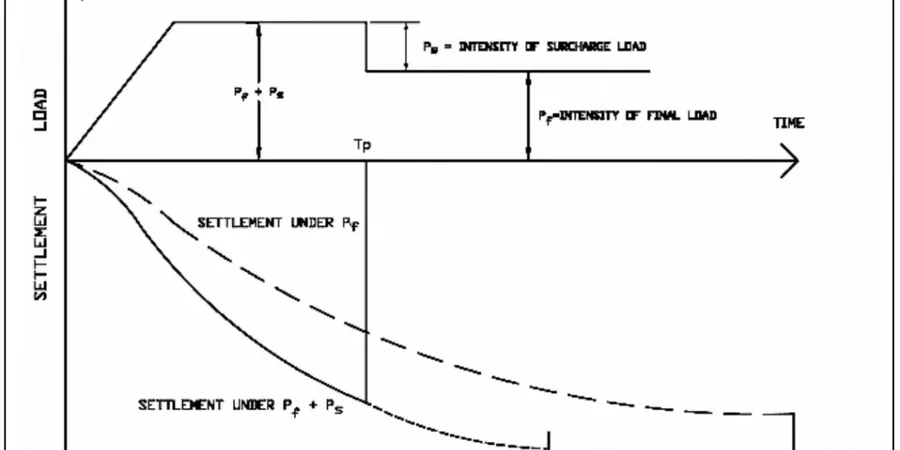
Using the lab parameters, we model one-dimensional consolidation for each soil layer. We calculate the fill height needed to achieve the target post-construction settlement (typically < 25 mm). We provide a staged fill schedule with monitoring milestones. The design includes pore pressure dissipation checks to avoid stability failures during loading.
Typical parameters
Frequently asked questions
How long does primary consolidation take in Fullerton's clay soils?
In the central basin, primary consolidation typically takes 18 to 36 months for a 3-meter clay layer with double drainage. The exact time depends on cv and drainage path length. We calculate t90 using the Terzaghi one-dimensional equation after we measure cv in the oedometer.
What is the typical cost range for a preloading design without surcharge in Fullerton?
The cost ranges from US$770 to US$2,320, depending on the number of oedometer tests, the depth of the clay layer, and whether CRS testing is needed. We provide a fixed-price quote after reviewing the site conditions.
Can preloading without surcharge work if the clay layer is thicker than 6 meters?
Yes, but the consolidation time becomes very long. For a 6-meter layer with double drainage, t90 can exceed 48 months. In those cases, we recommend combining the preloading design with vertical drains or deep soil mixing to accelerate settlement. We discuss these options during the site-specific evaluation.
How do you verify that the preloading design is working during construction?
We install settlement plates and piezometers at multiple depths. We monitor settlement rates weekly and compare them to the predicted time-settlement curve. If the measured rate deviates by more than 20%, we adjust the fill schedule or extend the wait period. Final verification comes from a post-construction plate load test.