A six-story apartment complex near Fullerton's downtown core required a raft foundation to spread loads across variable alluvial deposits. The site, located within the Coyote Hills fault zone, demanded careful evaluation of bearing capacity and differential settlement. Our team performed a detailed subsurface investigation, combining standard penetration tests with plate load testing to calibrate settlement predictions for the mat slab. The design accounted for the 0.4g peak ground acceleration specified by the California Geological Survey, ensuring the foundation could resist seismic uplift and rocking. Raft/mat foundation design in Fullerton must address these layered soil conditions to prevent structural distress over time.
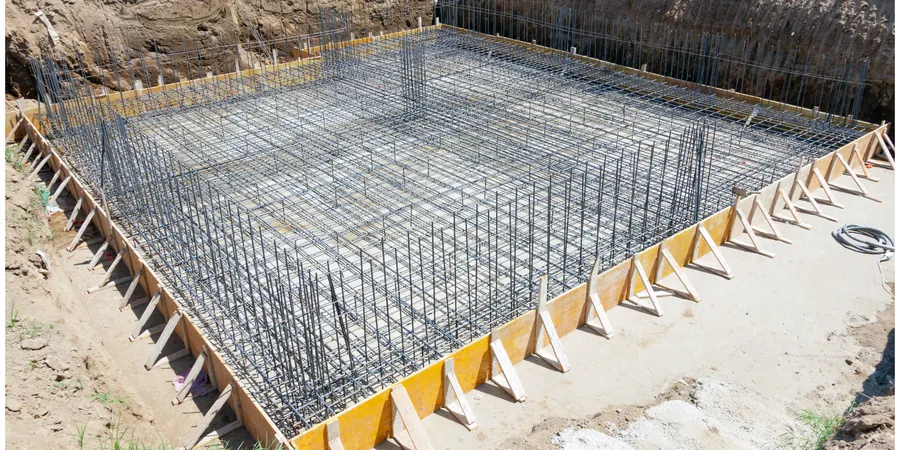
Raft foundations spread structural loads across variable alluvial soils, reducing differential settlement risk in seismically active zones like Fullerton.
Methodology and scope
Local considerations
Soils near the Fullerton Transportation Center are distinctly different from those along the Brea foothills. Downtown areas often contain loose silty sands with groundwater at 3–5 meters depth, while the northern hillside sites have stiff clays over bedrock. A raft foundation designed for one zone may fail in the other. The greatest risk is differential settlement caused by a buried channel or old streambed crossing beneath the mat. We always require a minimum of three borings per building footprint to delineate these features. Ignoring this variability can lead to slab cracking, uneven floor levels, and costly retrofits after occupancy.
Applicable standards
IBC 2021 (International Building Code, Seismic Design Category D), ASCE 7-22 (Minimum Design Loads for Buildings, Chapter 12), ACI 318-19 (Building Code Requirements for Structural Concrete), ASTM D1586-18 (Standard Test Method for SPT)
Associated technical services
Raft Foundation Design for Commercial Buildings
We engineer mat foundations for retail centers, office parks, and mixed-use developments in Fullerton. Each design includes bearing capacity analysis, punching shear checks, and seismic overturning verification per IBC 2021.
Raft Foundation Design for Residential Mid-Rises
For 4–8 story apartment buildings, we optimize slab thickness and reinforcement to minimize concrete volume while meeting drift and settlement limits. We provide shop-drawing-ready details for the contractor.
Typical parameters
Frequently asked questions
What is the typical cost for a raft foundation design in Fullerton?
The cost ranges from US$1,140 to US$4,020 depending on building size, number of borings, and complexity of the soil profile. This includes the geotechnical report and structural slab calculations.
How deep should a raft foundation be in Fullerton's alluvial soils?
Rafts are typically placed at 1.5–2.5 meters depth to reach competent bearing strata. In areas with shallow groundwater, we may recommend a drainage layer or waterproofing membrane beneath the slab. Depth is confirmed after reviewing SPT and CPT data from site-specific borings.
Can a raft foundation handle the seismic loads in Fullerton?
Yes, when designed per IBC 2021 and ASCE 7-22. The mat acts as a rigid diaphragm, distributing lateral forces to the soil. We check sliding, overturning, and uplift at the slab–soil interface. For sites near the Coyote Hills fault, we may add shear keys or grade beams to improve lateral resistance.