Our team mobilizes a vibratory hammer and tracked excavator to install test sections of sheet pile wall in Fullerton before full-scale design. We measure driving resistance, soil arching, and groundwater seepage on site. These field observations feed directly into our numerical models. For projects near the Coyote Creek flood channel or the 91 freeway corridor, we cross-check our assumptions with a dilatometer test to obtain lateral stress profiles. The combination of in-situ testing and calibrated analysis ensures the wall geometry matches the actual ground conditions in Fullerton, not generic textbook values.
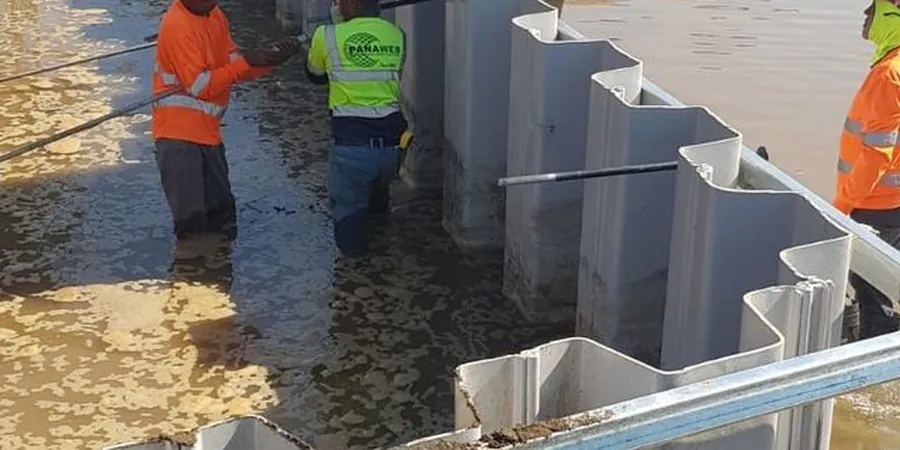
Sheet pile wall design must account for Fullerton's interbedded alluvial soils — one boring alone is rarely enough to capture the lateral variability.
Methodology and scope
Local considerations
IBC 2021 and ASCE 7 require that sheet pile wall design in Fullerton consider near-fault seismic effects due to the Whittier and Elsinore fault zones. The risk is not just lateral earth pressure but also liquefaction-induced lateral spreading in saturated alluvial fills. We run pseudostatic analyses with a horizontal seismic coefficient of 0.2g and check wall stability under post-earthquake conditions. Our laboratory acredited to ISO 17025 performs cyclic triaxial tests on sand samples to estimate strength loss. This approach prevents wall failure during a design earthquake event.
Applicable standards
IBC 2021 – Chapter 18 (Soils and Foundations), ASCE 7-22 – Seismic lateral earth pressures, ASTM A572/A572M – Steel sheet pile specification, FHWA NHI-05-045 – Design of sheet pile walls
Associated technical services
Cantilever Sheet Pile Walls
For excavations up to 6 m deep where tiebacks are not allowed. We select the section modulus and embedment depth based on active/passive pressure distribution from Fullerton's sand and clay profiles.
Anchored Sheet Pile Walls
Designed for deeper cuts or where lateral deflections must be limited. We size anchor rods, deadman blocks, or grouted tiebacks and verify pullout capacity using site-specific soil strength parameters from laboratory tests.
Cofferdam Design for Shoring
Temporary double-wall sheet pile cells for bridge abutments and pump station excavations in Fullerton. We check stability against overturning, sliding, and internal hydraulic gradients during dewatering.
Typical parameters
Frequently asked questions
What soil conditions in Fullerton affect sheet pile wall design the most?
Interbedded sand and clay layers with variable groundwater are the main challenge. Loose sands can densify during driving, while stiff clays may cause refusal. We always correlate blow counts from SPT tests with lab strength data to calibrate the design parameters.
How much does sheet pile wall design cost in Fullerton?
The cost range for engineering design and geotechnical investigation is typically between US$1.650 and US$5.760, depending on wall height, number of borings, and complexity of groundwater control. A detailed quote is provided after the initial site visit.
Do you design permanent or only temporary sheet pile walls?
We design both. For permanent walls, we add corrosion allowances per ASTM A572 and check long-term groundwater chemistry. Temporary walls follow a shorter service life but still meet IBC stability requirements for the construction duration.
What seismic design considerations apply to sheet piles in Fullerton?
Fullerton lies in Seismic Design Category D. We apply a horizontal seismic coefficient of 0.2g and check the wall for liquefaction-induced lateral spreading if loose saturated sands are present. Pseudostatic analysis and yield acceleration calculations are standard in our reports.