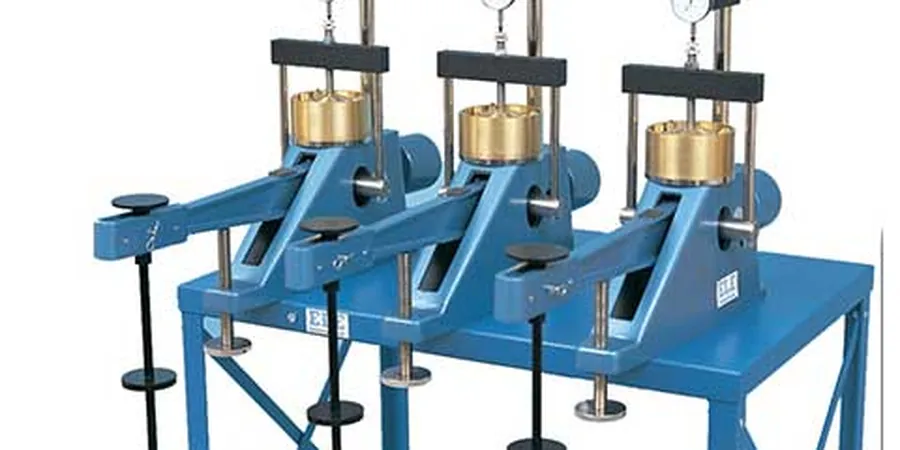
We use a fixed-ring oedometer with lever-arm loading frame to run consolidation tests on undisturbed samples from Fullerton. The specimen, trimmed into a 2.5-inch diameter ring, sits in a consolidation cell submerged in deionized water. Incremental loads double every 24 hours, and dial gauges record vertical deformation to 0.0001 inches. For projects near the Coyote Hills or the Santa Ana River floodplain, where soft alluvial clays dominate, this test provides the compression index (Cc) and preconsolidation pressure (σ'p) needed to predict long-term settlement under buildings. Our lab follows ASTM D2435-11, and results feed directly into the settlement analysis for mat foundations or pile groups. Before loading the oedometer, we often run a placa de carga to correlate modulus with field behavior.
For Fullerton's young alluvial clays, Cv typically ranges from 0.5 to 1.5 ft²/year, meaning primary consolidation can take months under a large footing.
Methodology and scope
Local considerations
ASCE 7-22 requires that foundation settlement be checked for all structures in Seismic Design Category D, which covers all of Fullerton due to its proximity to the Puente Hills thrust fault. If the oedometer consolidation test is skipped, the risk is differential settlement exceeding 1 inch between columns — something we've seen in several tilt-up warehouses near the 91 freeway. The preconsolidation pressure tells you whether the soil is normally consolidated or overconsolidated; misjudging that can lead to excessive total settlements that crack slabs and misalign door frames. In our experience, running the test on at least three depth intervals per boring is the minimum to capture the stratigraphic variability.
Applicable standards
ASTM D2435-11 (Standard Test Methods for One-Dimensional Consolidation Properties of Soils), ASTM D2487-17 (Standard Practice for Classification of Soils for Engineering Purposes), ASCE 7-22 (Minimum Design Loads and Associated Criteria for Buildings and Other Structures)
Associated technical services
Consolidation test on undisturbed samples
Standard 24-hour incremental loading with 8 to 10 load steps, reporting Cc, Cr, Cv, and σ'p. Results delivered in a certified report within 10 business days.
Swelling pressure test
Oedometer method with controlled volume change to measure swell pressure under zero deformation. Critical for slab-on-grade designs in expansive clay zones.
Consolidation with permeability
Falling-head permeability test performed directly in the oedometer cell after each load increment. Provides k (hydraulic conductivity) for drainage analysis.
One-dimensional creep test
Extended loading at constant stress for 7-14 days to evaluate secondary compression (Cα). Used for landfills, embankments, and high-rise tower foundations.
Typical parameters
Frequently asked questions
How long does an oedometer consolidation test take?
A standard test with 8 load increments runs 8 to 10 business days, including sample preparation, saturation, and data reduction. Extended creep tests can take 3 weeks.
What is the difference between Cc and Cr in the oedometer test?
Cc (compression index) measures the slope of the virgin compression curve, used to calculate settlement in normally consolidated clays. Cr (recompression index) is the slope during unloading-reloading, used for overconsolidated soils and rebound estimates.
Can the oedometer test be used for sandy soils?
No. The oedometer is designed for fine-grained soils (clays and silts) with low permeability. For sands, we use the plate load test or triaxial compression. The consolidation theory assumes saturated, low-permeability conditions.
What sample quality is needed for a reliable oedometer consolidation test?
Undisturbed thin-wall tube samples (Shelby tubes) with minimal disturbance. Samples must be stored sealed and tested within 30 days. If the sample shows desiccation cracks or water loss, the test results are invalid.
How much does an oedometer consolidation test cost in Fullerton?
The typical range for a standard consolidation test is US$200 to US$480 per specimen, depending on the number of load increments and whether swelling or permeability is included. Volume discounts apply for multiple depths.