Fullerton sits on deep alluvial deposits from the Santa Ana River, with groundwater levels that vary sharply between the Coyote Hills foothills and the flat valley floor. That contrast in sediment thickness and stiffness directly affects how the ground shakes during an earthquake. Our HVSR microtremor survey uses the Nakamura method to measure the horizontal-to-vertical spectral ratio of ambient vibrations, giving us a clear picture of the site's fundamental resonance frequency. Before any structural design begins, we deploy portable seismometers at multiple points across the property to capture that signal. The result is a reliable estimate of soil amplification potential, which feeds directly into the site class definition required by ASCE 7-22. For projects in Fullerton's older fill zones, we often pair the survey with a study of expansive soils to cover both dynamic settlement and volumetric change risks.
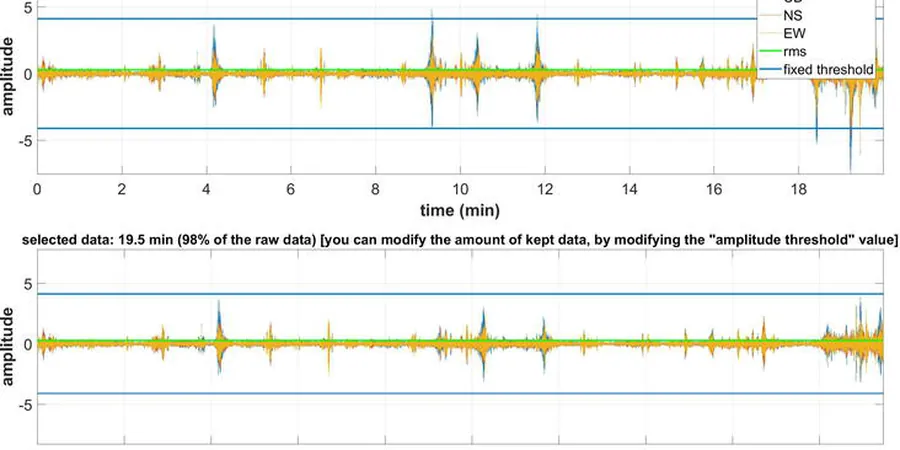
The resonance frequency measured by HVSR directly controls the site class and the design response spectrum in ASCE 7-22.
Methodology and scope
Local considerations
A four-story apartment complex in central Fullerton was recently built on undocumented fill over old agricultural soils. The structural engineer assumed a Site Class D, but the HVSR microtremor survey revealed a resonant peak at 0.9 Hz, consistent with deep soft clay layers not identified in the original boring logs. That mismatch meant the design spectrum underestimated the spectral acceleration at the building's fundamental period. The fix required re-evaluating the foundation plan and adding stiffness at the base. Without the survey, the building would have been vulnerable to long-period shaking from a distant earthquake on the San Andreas fault. That kind of oversight is exactly what we help avoid.
Applicable standards
SESAME (2004) – Guidelines for the implementation of the H/V spectral ratio technique on ambient vibrations, ASCE 7-22 – Minimum Design Loads and Associated Criteria for Buildings (Section 20.3, Site Classification), ASTM D7400-19 – Standard Test Methods for Downhole Seismic Testing (reference for sensor calibration)
Associated technical services
Grid HVSR Survey
Multi-station array covering the entire site to produce a resonance frequency contour map. Ideal for large lots or campuses where soil conditions change laterally.
Single-Station HVSR
Rapid assessment of one or two points for feasibility studies or pre-design screening. Quick turnaround, minimal surface disruption.
HVSR plus MASW Integration
Combined passive (HVSR) and active (MASW) surface wave methods to obtain both resonance frequency and shear-wave velocity profile (Vs30). Direct input for ASCE 7 site class.
Time-History Calibration
Use the measured H/V curve to calibrate site-specific ground motion time histories for dynamic analysis. Essential for performance-based design in Fullerton's basin areas.
Typical parameters
Frequently asked questions
What is the difference between HVSR and traditional seismic refraction?
Seismic refraction uses an active source (hammer or weight drop) and measures P-wave velocities to map layer boundaries. HVSR uses ambient noise only, measuring the horizontal-to-vertical spectral ratio to find the soil's fundamental resonance frequency. HVSR is passive, faster, and gives direct information on how the site amplifies earthquake shaking.
How many HVSR stations do I need for a typical Fullerton residential lot?
For a standard single-family lot (5,000 to 10,000 sq ft), we recommend 3 to 5 stations. That covers the main soil variability within the footprint. For larger commercial parcels, 5 to 10 stations on a grid is standard. The array spacing depends on the expected heterogeneity of the alluvial deposits.
Does HVSR replace the need for a geotechnical boring?
No. HVSR gives dynamic properties (resonance frequency, amplification factor) but does not replace borings for soil classification, strength, or groundwater data. We always recommend combining HVSR with at least one boring per site to correlate the resonance peak with the actual soil stratigraphy.
What is the typical cost range for an HVSR survey in Fullerton?
The cost for a professional HVSR microtremor survey in Fullerton ranges between US$1,480 and US$2,620 depending on the number of stations, site access conditions, and reporting level. This includes field deployment, data processing, and a technical report with H/V curves and site class recommendation.