Fullerton's development from a historic citrus hub into a dense suburban core means many of its arterial roads and residential streets were laid decades ago, often over undocumented fills and variable alluvium from the Coyote Creek watershed. When we assess existing pavements here, we routinely encounter sections that have been patched multiple times without addressing the subgrade's true bearing capacity. A thorough existing pavement evaluation identifies where those quick fixes masked deeper issues like pumping fines or trapped moisture, which then guides whether a mill-and-overlay will hold or if full reconstruction is needed. Before specifying any treatment, we correlate surface distresses with underlying soil conditions through test pits and dynamic cone penetration, complementing the visual survey with a targeted subrasante vial analysis to confirm the subgrade's support value across the project length.
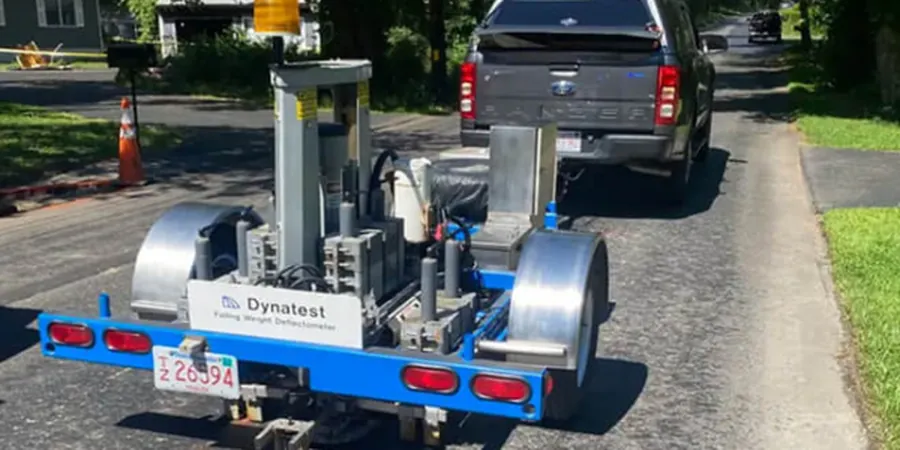
A proper existing pavement evaluation catches subgrade softening before the overlay goes down, preventing reflective cracking within the first two years.
Methodology and scope
Local considerations
A common mistake we see with Fullerton contractors is relying solely on visual distress surveys without soil sampling. They assume that because the surface looks sound, the subgrade is equally stable. That assumption fails when the pavement sits on silty sands that lose strength with moisture. We had a case on a local collector road where a 4-inch overlay cracked within 18 months because the existing base was contaminated with fines from a leaking irrigation line. Only a proper existing pavement evaluation that included moisture profiling and CBR testing would have caught that before the overlay bid.
Applicable standards
ASTM D5361 (Pavement core extraction), ASTM D4694 (Falling weight deflectometer), AASHTO T-88 (Particle size analysis of subgrade), ASTM D2844 (Resistance R-value), ASTM D1586 (Standard penetration test)
Associated technical services
Distress and Condition Survey
Systematic mapping of cracking, rutting, raveling, and patching across the project length, using the ASTM D6433 PCI method to assign a numerical condition index.
FWD Deflection Testing and Backcalculation
Falling weight deflectometer readings at 500 ft intervals with layer moduli backcalculation per AASHTO T-256, giving the effective structural number of the existing pavement.
Coring, Test Pits, and Laboratory Classification
Full-depth coring and test pits for layer thickness verification, plus Atterberg limits, moisture content, and R-value on subgrade samples to calibrate rehabilitation designs.
Typical parameters
Frequently asked questions
What is the typical cost range for an existing pavement evaluation in Fullerton?
For a standard urban street section (one mile, two lanes), the cost ranges between US$1.330 and US$3.410 depending on coring density and whether FWD testing is included. Larger arterial projects with multiple test pit locations fall at the higher end.
How deep do the test pits need to go for a reliable existing pavement evaluation?
We excavate test pits to at least 2 feet below the bottom of the lowest pavement layer, or until we encounter competent subgrade. In Fullerton's alluvial soils, that typically means a pit depth of 3 to 4 feet from the finished surface.
Can the evaluation be done while the road is open to traffic?
Yes, most field work runs under lane closures with traffic control. Coring and FWD testing cause minimal disruption, while test pits require a single-lane closure for about two hours per location.
What ASTM standards govern the coring and testing procedures?
We follow ASTM D5361 for core extraction, ASTM D4694 for FWD deflection readings, and ASTM D2844 for R-value determination on subgrade samples. All laboratory testing adheres to AASHTO T-88 and ASTM D4318 where applicable.